Tata Power & Norway’s Ocean Sun Partner for Floating Solar Solutions

Tata Power Ltd. has entered into a partnership with Norway-based Ocean Sun AS to introduce its proprietary membrane-based floating solar technology in India. The agreement was formalized on the sidelines of 2nd India-EFTA Prosperity Summit.
This arrangement is a technology partnership, where Ocean Sun will provide the core technology and Tata Power will handle project execution and retain ownership of all project assets.
Tata Power to Deploy 300 kWp Floating Solar Pilot Project
Under the partnership, Tata Power and Ocean Sun will undertake a 300 KWp floating solar pilot project at Tata Power’s Mulshi reservoir in Maharashtra. The companies will install Ocean Sun’s patented thin hydro-elastic membrane technology for evaluating its potential under Indian conditions.
Distinct features of Ocean Sun’s Floating Membrane Technology
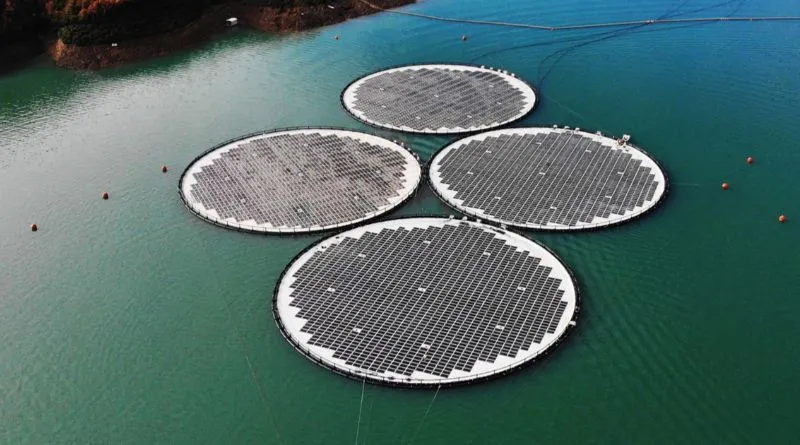
Ocean Sun’s patented design is for replacing conventional floating solar systems. While conventional systems use bulky and heavier interconnected pontoon structures*, Ocean Sun’s technology features a thin, lightweight, hydro-elastic membrane-based floating solar platform.
Due to this thin membrane design, solar PV modules are in close proximity to the water surface. Consequently, the cells experience a cooling effect, which might improve their power generation performance. Moreover, being lightweight ensures ease in logistical handling during transportation and installation.
*A pontoon structure is a hollow, airtight, or flat-bottomed buoyant unit used to provide support and stability on the water. These bulky pontoon structures are interconnected to creating a floating platform for deployment of solar modules.
Evaluating Technology Performance Under Indian Conditions
The pilot project is for evaluating how Ocean Sun’s technology performs under Indian climatic, water, and grid conditions. Tata Power will assess this technology’s performance, reliability, cost competitiveness, and scalability against conventional floating solar systems. Also, it will cover evaluation of capital cost, overall commercial suitability, and generate operating insights for potential future deployment.
National Institute of Solar Energy (NISE) estimates India’s floating solar potential at over 102 GWp. The Mulshi pilot will provide operational field data necessary to determine whether the membrane-based technology can be deployed on a wider scale across India’s reservoirs. Solar parks need a lot of space, hence realization of India’s floating solar potential will be beneficial and support clean energy transition goals.